Systems, not sentiment.
Organizations and partnerships bring together people with different knowledge, responsibilities, and priorities. Their success depends on whether those contributions can come together in ways that strengthen the whole.
I help organizations and multi-stakeholder initiatives identify what prevents collective progress and create the conditions for stronger coordination, better decisions, and shared results. My work combines organizational science, neuroscience, systems thinking, and the Andean principle of reciprocity, grounded in more than two decades of experience building partnerships and advancing collective action.
For leadership teams and organizations
For coalitions, platforms, and multi-stakeholder initiatives.
Organizations
Where collaboration breaks down
Organizations that come to Living Ayni have capable people and clear missions. And yet the work keeps breaking down between them, in ways that have started to feel normal: teams optimizing for their own goals at the expense of the whole, two groups working on the same problem without knowing it, breakdowns that take longer and longer to surface, and the same people absorbing extra work and risk until burnout clusters in the same roles. Leadership senses something is off but can't locate exactly where.
The cause is often systemic. Every organization decides what it rewards, what it pays attention to, and whose views are heard before a commitment is made. Over time those choices become defaults, and their costs land quietly on the teams closest to the work. Living Ayni helps reveal where contribution and benefit have come apart, brings people across organizational levels into understanding those patterns, and supports leadership in deciding what to change and measuring whether it worked.
The work rests on ayni, the Andean principle of reciprocity, and decades of research in organizational science. Both offer insight into why cooperation depends on relationships of mutual contribution, fairness, and responsibility. Neuroscience adds an understanding of how expectations, stress, and social conditions influence people's ability to think clearly, learn, and trust one another.
The work addresses two interconnected levels: the organizational conditions shaping collaboration and the people whose decisions and relationships sustain or change them.
The Living Ayni Workshop
In person over one to three days, or virtually across several weeks, built around your timing and deadlines.
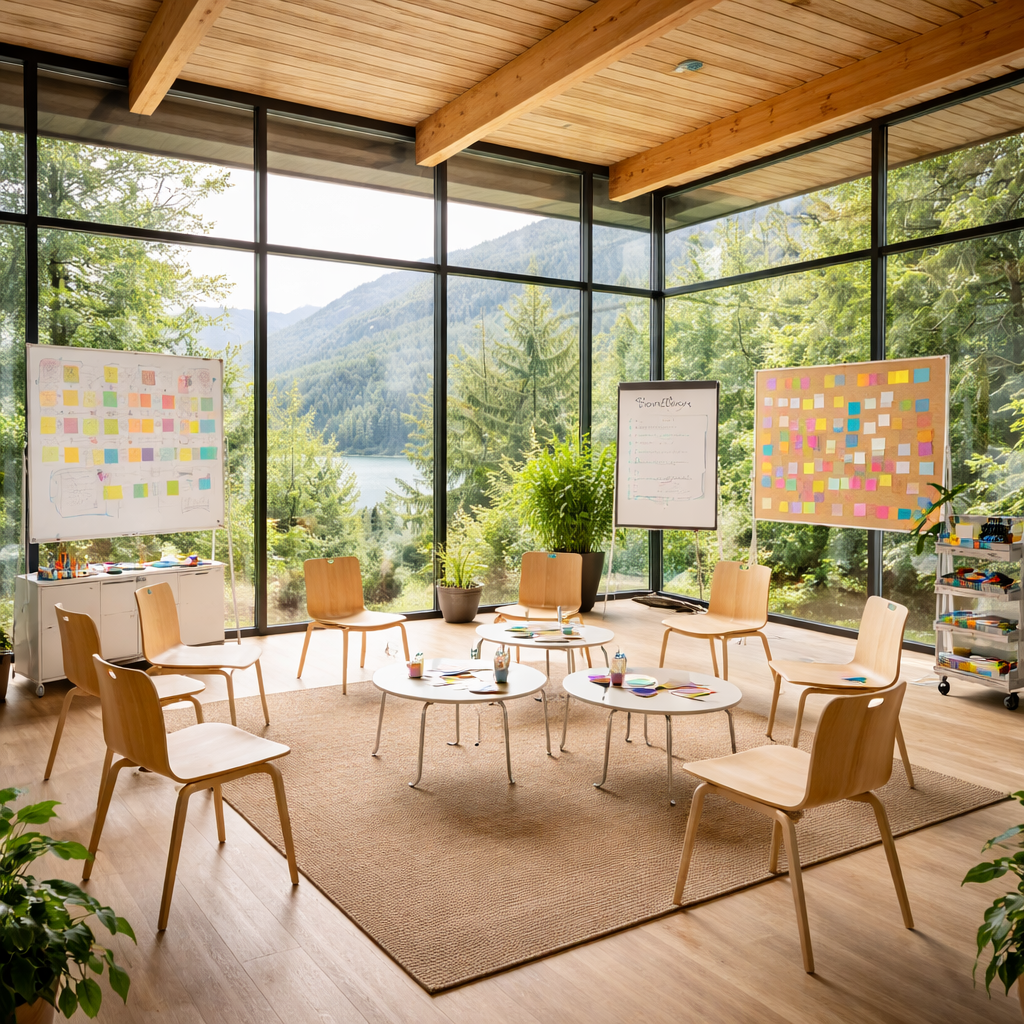
A facilitated process for leadership teams and organizations ready to examine what is actually shaping how people coordinate and make decisions. Every workshop involves both leadership and the teams doing the work, and moves through four stages.
Reciprocity Alignment Scan. A short anonymous survey and facilitated conversations establish a baseline, the Reciprocity Index, showing where misalignment lives, how trade-offs move through the system, and where collaboration is more form than substance.
Four Gates and Four Directions. Facilitated sessions take the findings through a structured discernment process: what is real, what matters, what is the impact, what is possible. The collaborative shape of the teams becomes visible, along with how it plays out in handoffs, deadlines, and decisions.
Redesign decisions. Leadership decides what changes in incentives, metrics, and decision processes. Each decision is recorded with an owner, start date, and implementation plan.
Re-measurement. In the months after the workshop, the same survey and the indicators chosen at the start are run again, so progress is judged against the organization's own baseline. Results are reported either way.
Participants do the mapping themselves, using Living Ayni's frameworks as the lens. What leaves with them is a shared understanding of what's actually happening, ownership of the direction forward, and a set of design decisions with measurement around them. There are no personality assessments, no individual evaluations, and no culture programming. The workshop works well on its own and as an entry point for longer work.
Living Ayni Leadership Development
Multi-month engagement
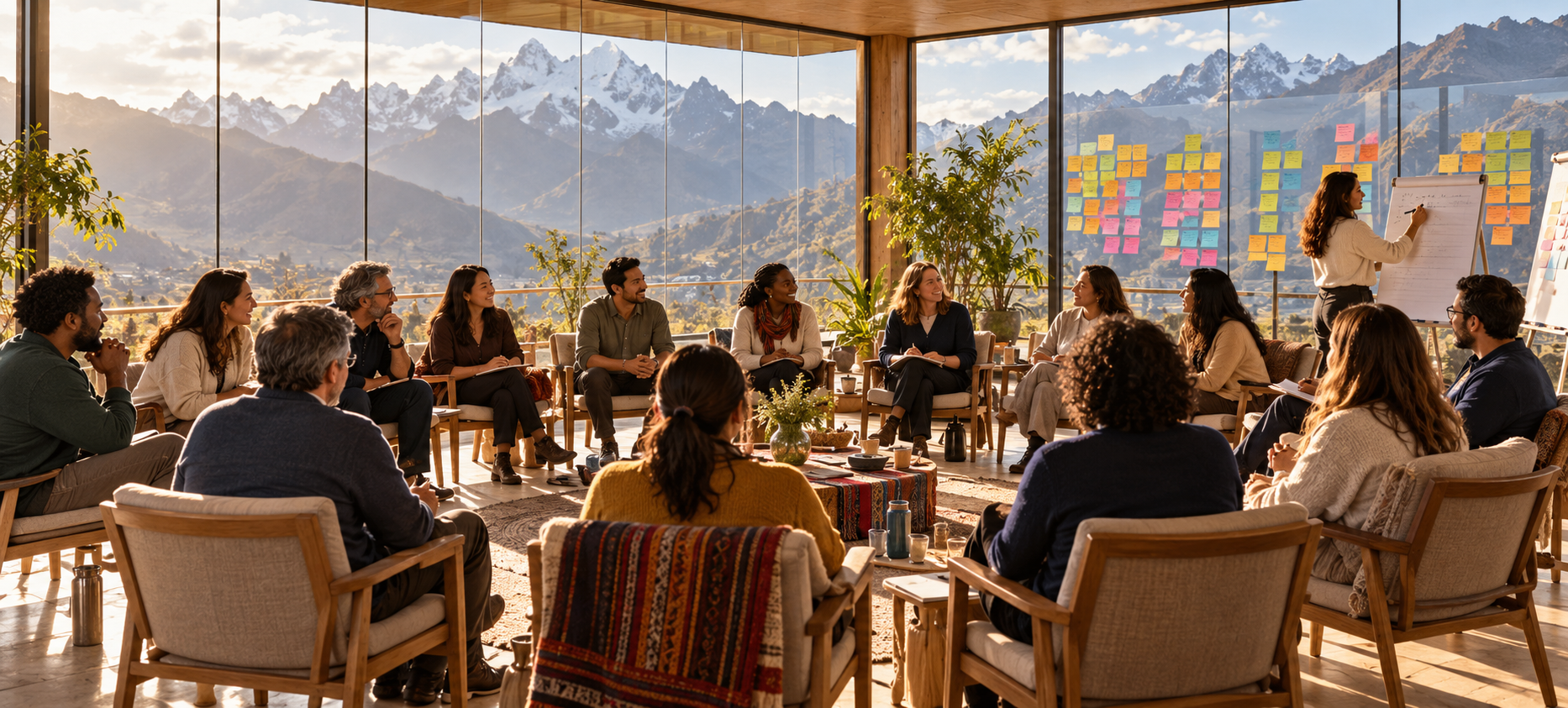
For organizations ready to go beyond a single workshop, this engagement combines facilitated dialogue, leadership and team development, and coaching with continued attention to the conditions shaping collaboration.
People across the organization develop a deeper understanding of their own patterns and the perspectives of others, while practicing new ways of communicating, making decisions, and taking shared responsibility. Leadership continues to examine how incentives, measures of success, and decision processes support or undermine those practices.
The aim is to build the internal capacity to sustain more effective coordination, stronger relationships, and organizational conditions in which teams have a genuine stake in one another's success.
Coalitions & Collective Action
Turning shared ambition into collective results.
Some of the world's most pressing challenges require organizations with different mandates, capabilities, and interests to work together. Multi-stakeholder platforms and coalitions create opportunities for collective action, but bringing stakeholders together is only the beginning.
Initiatives can overlap without participants realizing it. Organizations may compete for funding, visibility, or influence while pursuing similar goals. The people most affected by decisions may have limited influence over them. And progress can be measured through meetings, commitments, and activities even when the outcomes everyone cares about remain stubbornly out of reach.
Having worked within global partnerships and sustainability initiatives, I understand both the potential of these platforms and the institutional dynamics that can prevent them from delivering on their promise.
I facilitate strategic processes that help stakeholders examine the realities behind their collective efforts, understand one another's priorities and capabilities, and make decisions about how to achieve more together.
This includes confronting questions that are often difficult to raise: Where are we duplicating work? What could another stakeholder do better than us? Whose knowledge are we overlooking? Why is collective action falling short despite widespread commitment? And what would need to change for shared responsibility to translate into measurable progress?

What you can expect
A clearer understanding of the barriers to collective action
Greater alignment around shared priorities and intended outcomes
Clarity about stakeholder roles, capabilities, and comparative advantages
Identification of duplication, gaps, and conflicting incentives
Strategic choices about what to continue, change, consolidate, or stop
Agreed responsibilities, next steps, and measures of collective progress
Engagements can support strategy development, partnership reviews, stakeholder alignment, and moments when an initiative needs to reconsider how it operates.
From listening to redesign
Organizations put enormous resources into bringing people together: leadership retreats, stakeholder consultations, cross-functional meetings. People can still leave the same conversation with very different understandings of what was said and what should happen next.
Neuroscience helps explain why. The brain interprets incoming information through predictions built from past experience, and our goals and responsibilities shape both what we notice and how we encode it in memory.
Ayni holds that what we receive carries responsibility for how we use it. To listen reciprocally is to let what we receive from others change how we understand, decide, and act. It is a skill that rarely comes naturally, and most teams need an experienced facilitator to build it.
Listening alone cannot sustain that change. Incentives, decisions, and measures of performance have to make acting on what people learn from one another worthwhile, which is where the organizational design work begins.
AI raises the stakes
Most AI rollouts are measured by how many individuals use the tools well. New research suggests the cost shows up at the team level. In a survey of more than 1,000 U.S. desk workers published in Harvard Business Review, teams where people routinely turned to AI instead of a colleague reported coordination and trust more than 20 percent lower. People lost track of who knows what on their team, and many described feeling isolated. Among the drivers the researchers identify are incentives that reward individual productivity with AI over collective results.
This is the same imbalance Living Ayni works on, and AI is accelerating it. AI can also move costs between teams, with one function capturing the productivity gains while another absorbs the checking, integration, and downstream risk. I help organizations see how AI is changing the flow of knowledge, work, and responsibility, and redesign incentives and decisions so that stronger individual capability adds up to stronger collective performance.
Additional ways to work together
Alongside integrated organizational engagements and multistakeholder strategy processes, I offer focused strategic facilitation, leadership and team workshops, one-to-one coaching in English or Spanish, and advisory support. These engagements are tailored to specific decisions, transitions, or collaboration challenges. Nonprofit organizations receive a discount.
Every engagement begins with a conversation about what is happening in your organization or partnership, what you want to achieve, and whether working together makes sense.